
koh samui building regulations
Koh Samui Building Regulations
Before you fall in love with a sea view, you need to know what you can legally build on it.
Koh Samui is one of Thailand’s most tightly regulated islands. Between beach setback rules, hillside altitude bands, steep slopes and new environmental zoning, your villa or resort concept lives or dies on compliance. Archi Studio’s Koh Samui team uses these regulations as design inputs – not afterthoughts – so you don’t end up with a masterplan that can’t be approved.
Slope Rules: Designing Hillside Villas Without Getting Stopped
Two plots at the same altitude can have totally different rules if one is gently sloping and the other is a steep hillside.
Koh Samui building regulations Stack
Koh Samui development is governed by multiple layers of rules that all overlap on the same plot:
National building laws
Thailand’s Building Control Act and Town & City Planning Act set the national baseline: building safety, distances from public roads and waterways, and what can be built close to the beach.
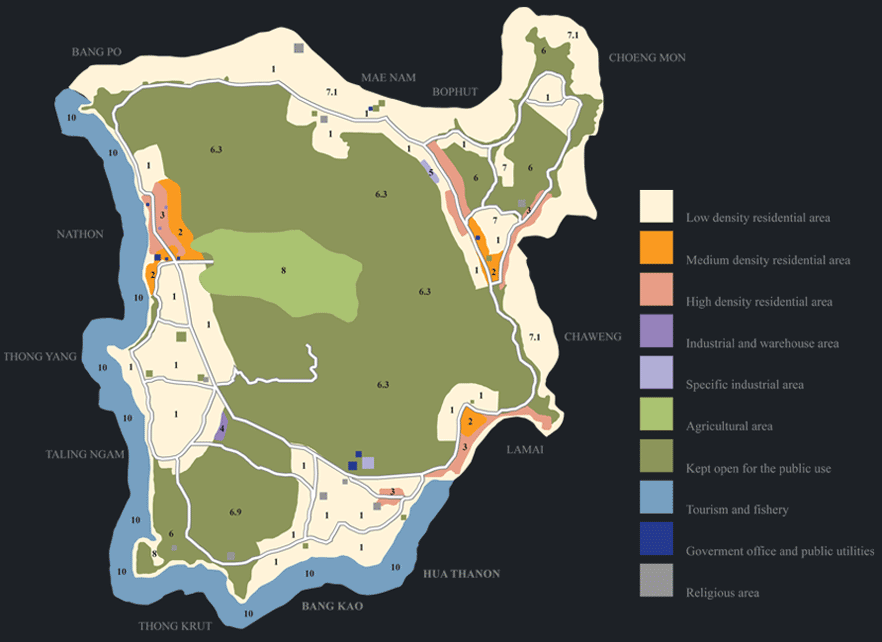
Samui-specific zoning and environmental protection
Koh Samui, Koh Phangan and Koh Tao are designated environmentally protected zones, with island-level zoning that defines residential, commercial and “green” conservation areas, plus stricter coastal and hillside controls.
New environmental zoning updates (2025)
Recent zoning updates refine hillside categories above 80 m and 140 m, with bands that limit building height, footprint, unit count and subdivision, especially in steep or high-visibility areas.
Distance from the Beach: 0–10 m, 10–50 m, 50–200 m and Beyond
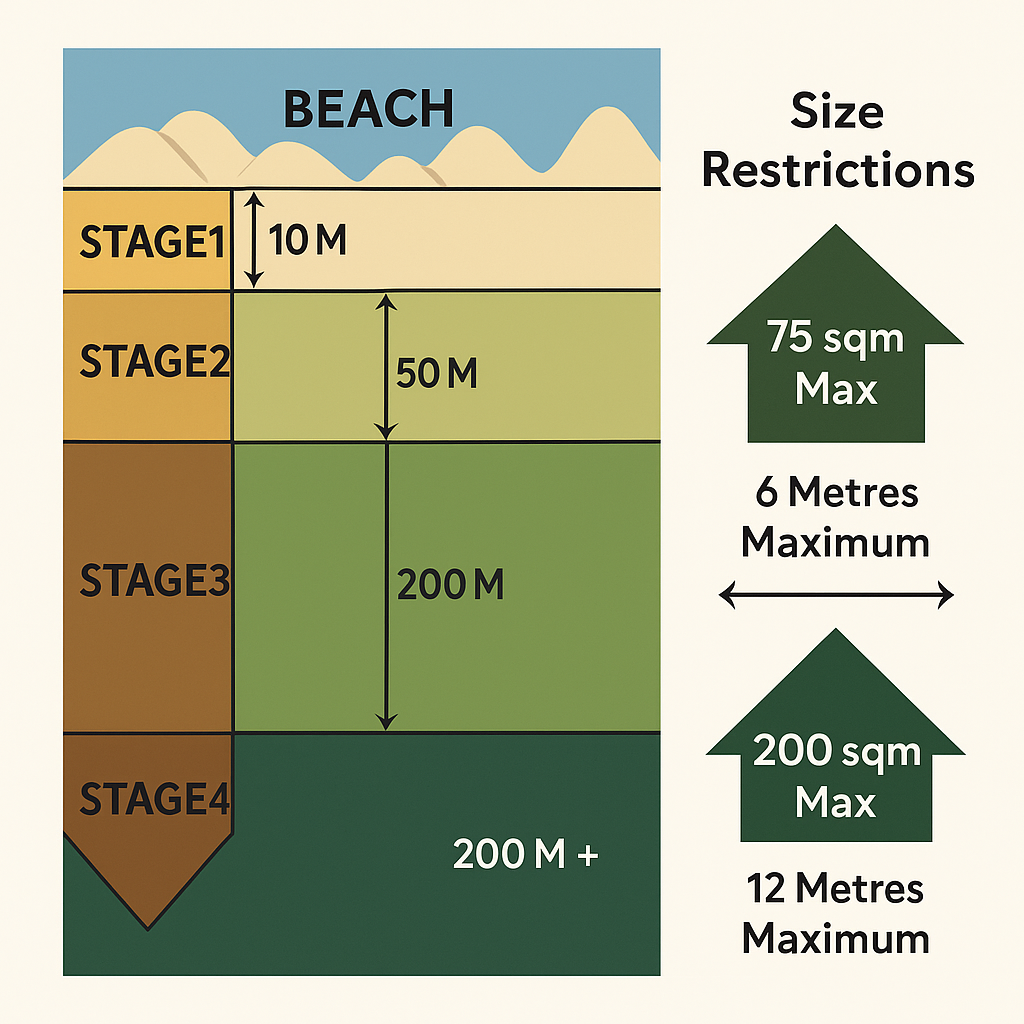
The first 200 m from the official shoreline are heavily controlled. What you can build depends on your distance from the sea:
0–10 m from the beach (Area 1)
Construction is generally prohibited. This strip is effectively a coastal protection buffer; think landscape, not buildings.
10–50 m from the beach (Area 2)
- Only single-storey buildings
- Max height 6 m, including the roof
- Max total floor area 75 m² per building
- High open-space ratio around the structure (often 75% of the land)
In practice, this band suits light pavilions or small beachfront villas, not big concrete blocks.
50–200 m from the beach (Area 3)
- Larger buildings up to 2,000 m² are permitted
- Max height typically 12 m, including the roof
- Roofs must be pitched, with natural, non-reflective finishes
This is the main zone for villas, low-rise resorts and clubhouses – if other zoning and environmental conditions are also satisfied.
Beyond 200 m (Area 4)
- Max height generally 12 m
- Pitched roofs are still standard, and other limits now come mainly from altitude, slope and zoning.
Beyond 200 m the beach rules relax, but hillside and environmental restrictions usually tighten, especially on steeper slopes and higher ridgelines.
Altitude Bands: Below 80 m, 80–140 m and Above 140 m
Altitude drives how “sensitive” your land is in the eyes of the regulator:
Below 80 m above sea level (Lowland)
Standard villas and low-rise blocks are generally possible, subject to beach distance, zoning and infrastructure. Hotels and larger developments still need adequate green space and proper water/waste systems.
80–140 m above sea level (Hillside)
In many new hillside environmental zones, rules typically include:
- Only one single-family home per plot in certain bands
- Minimum land size around 400 m² (or more, depending on the zone)
- Max building height of about 6 m, including the roof
- At least 50% of the land to remain unbuilt and green
- Tropical roof forms with natural colours; no harsh reflective materials
- Proper stormwater drainage is mandatory
Above 140 m above sea level (High hillside)
- Same core rules as the hillside band (single home, 6 m height cap, 50% green)
- Tighter cap on building footprint (often around 90 m² in stricter zones)
- Higher scrutiny on visual impact, drainage, erosion control and tree retention

Slope under 35%
Usually treated closer to “normal” land. Beach distance, altitude and zoning still matter, but you’re not yet in the tightest hillside restrictions.
Slope between 35% and 50%
In many Samui guidelines and practice, this is high-risk terrain:
- Only one house per plot is typically allowed
- Height often capped around 6 m, including the roof
- Tight limits on building footprint (≈80–90 m² depending on zone)
- Large portions (up to 70–75%) must remain unbuilt, with many existing trees preserved
- Earthworks, cut-and-fill and retaining walls are tightly controlled
Slope above 50%
Construction is generally prohibited. These red or “no-build” zones are treated as protected hillside; authorities actively target illegal villas on such slopes under initiatives like the “Samui Model”.
Zoning Maps and the 2025 Environmental Update
Recent environmental zoning laws for Koh Samui, Koh Phangan and Koh Tao tighten controls on where and how you can build:
Coastal and lowland zones
- Stricter size and key-count limits for hotels and resorts
- Mandatory wastewater treatment and infrastructure for larger projects
- Designated “green” zones where construction is heavily restricted or banned
Hillside environmental zones (≥80 m and ≥140 m)
- Dedicated bands (often mapped as Zone 3(1), 3(2), etc.)
- “Single-family-only” rules in many hillside categories
- Tight caps on building footprint and unit density
- Restrictions on land subdivision and resort-style multi-unit layouts
- Higher requirements for open space and tree preservation
For each new brief, Archi Studio cross-checks your Chanote against the latest planning and environmental maps, then builds your masterplan inside those boundaries – instead of trying to negotiate exceptions later.
Permits, IEE / EIA and Required Documentation
What are the basic building regulations in Koh Samui for villas and resorts?
Building regulations in Koh Samui control what you can build based on distance from the beach, altitude, slope and zoning. Within 50 m of the shore, only small single-storey buildings are allowed; hillside land above 80 m and steep slopes face strict height, footprint and green-space limits, plus possible environmental approvals.
Pretty 3D renders don’t get permits.
Authorities expect a technically complete package that complies with national law and Samui’s local rules:
Land due diligence & feasibility
- Chanote verification and boundary checks
- Zoning, altitude and slope analysis
- Drainage risk, access, existing infrastructure and utilities
- Early kill/adjust decisions on unrealistic concepts
Architectural & engineering design
- Concept and detailed architecture
- Structural, MEP, drainage and wastewater systems to Thai standards
- Roof forms, materials and massing tuned to environmental rules
Building permit submission
- Full drawing set, calculations and forms
- Submission to local OrBorTor / Tessaban and related agencies
- Involvement of a licensed Thai engineer of record for most serious projects
IEE / EIA / EHIA (where required)
- Larger hotels, resorts and high-impact uses may trigger Initial Environmental Examination (IEE) or full EIA/EHIA
- Accredited environmental consultants prepare reports; Archi Studio coordinates design, mitigations and documentation
Construction oversight & compliance
- Built works must follow the approved permit set and environmental commitments
- Significant deviations can lead to stop-work orders, fines or mandatory rectification
How Archi Studio & Ancra De-Risk Your Samui Project
Archi Studio started in Koh Samui and now operates with a full design + build stack on the island alongside our construction arm, Ancra.
Compliance-first masterplanning
- We map altitude, slope, beach distance and zoning before sketching.
- Parametric tools let us test unit counts, villa layouts, access roads and view corridors within height, footprint and open-space limits.
- Drainage, retaining and infrastructure are baked into early concepts instead of patched at the end.
Design that passes review
- Contemporary tropical villas with pitched roofs, natural colours and broken massing that read “light” on the hillside.
- BIM-based documentation for clean coordination with Thai engineers and authorities.
- Detail-driven drainage and retaining strategies tuned for monsoon conditions.
One stack: design → permits → build
- Archi Studio handles architecture and interior design.
- Ancra manages construction and on-site delivery, including structural works and MEP.
- Our manufacturing capability supports precision joinery and fit-out for villas, resorts and hospitality.
AI-assisted rule checking
- Internal AI tools trained on Samui regulations help flag risk zones early and run “what if” scenarios on plot division, key count and massing.
- Human architects, Thai consultants and legal partners validate final decisions.
Common Questions About Koh Samui Building Regulations
Q1. Can I build a two-storey villa on hillside land above 80 m?
In many hillside zones you’re limited to a maximum building height of around 6 m, including the roof, with only one home per plot. That may still allow split-level, partially sunken designs, but the overall profile must stay low. We model these constraints early so your villa remains both generous and legal.
Q2. Are flat roofs allowed on Koh Samui?
Most coastal and hillside regulations expect pitched, tropical-style roofs in natural colours. Flat roofs and reflective materials are heavily discouraged and can trigger rejections. We use contemporary tropical roof forms that feel modern but remain compliant with local guidelines.
Q3. When do I need an IEE or full EIA?
Environmental reports are typically required for larger hotels, resorts and high-impact commercial projects, especially in sensitive hillside or coastal zones. Thresholds depend on built area, number of keys and location. In feasibility, we benchmark your project against current criteria and, where needed, bring in accredited environmental consultants.
Q4. What happens if an existing villa on the land is non-compliant?
Non-compliant structures can become liabilities: authorities may issue stop-work orders, fines or require demolition. Before you buy or renovate, we compare the existing building against permits and current rules, then advise whether to keep, upgrade or redesign.
Q5. Can Archi Studio handle both the design and the construction on Samui?
Yes. Archi Studio leads architecture and interior design, while our sister company Ancra handles construction, site works and coordination with local authorities. You get one integrated team from feasibility through handover.
Q6. How long does the permitting process usually take?
Timelines vary by project type, documentation quality and authority workload. Simple single-villa permits may proceed in a few months; larger multi-villa or resort projects, especially with IEE/EIA, require longer. We structure the process in phases so design, costing and approvals run in a managed pipeline instead of stalling your investment.
Q7. Do you work with overseas developers and investors?
Yes – a large part of our portfolio is for overseas owners and developers. We bridge local regulations with international expectations, providing clear English communication, digital progress reporting and transparent risk flagging.
Legal Disclaimer
This page is a general overview of Koh Samui’s building rules and regulations for informational purposes only. It is not legal advice and should not be relied on as such. Regulations and their interpretation can change, and specific plots may be subject to additional or different rules. Always confirm current requirements with local authorities, licensed Thai professionals and legal counsel before making investment or construction decisions.
⚠️ 2026 Update: Authorities have launched the “Samui Model” task force to strictly enforce these zoning codes using aerial surveillance. For details on the current crackdown and demolition orders, read our construction partner’s report on Koh Samui Construction Laws & The 2026 Crackdown.
Check Your Land’s Feasibility
Send us your land details or Chanote title for a preliminary regulatory check